
Creating a Webhook

In the Commerce product dashboard, under the “Webhooks” section, you can create webhooks to subscribe to available event types.
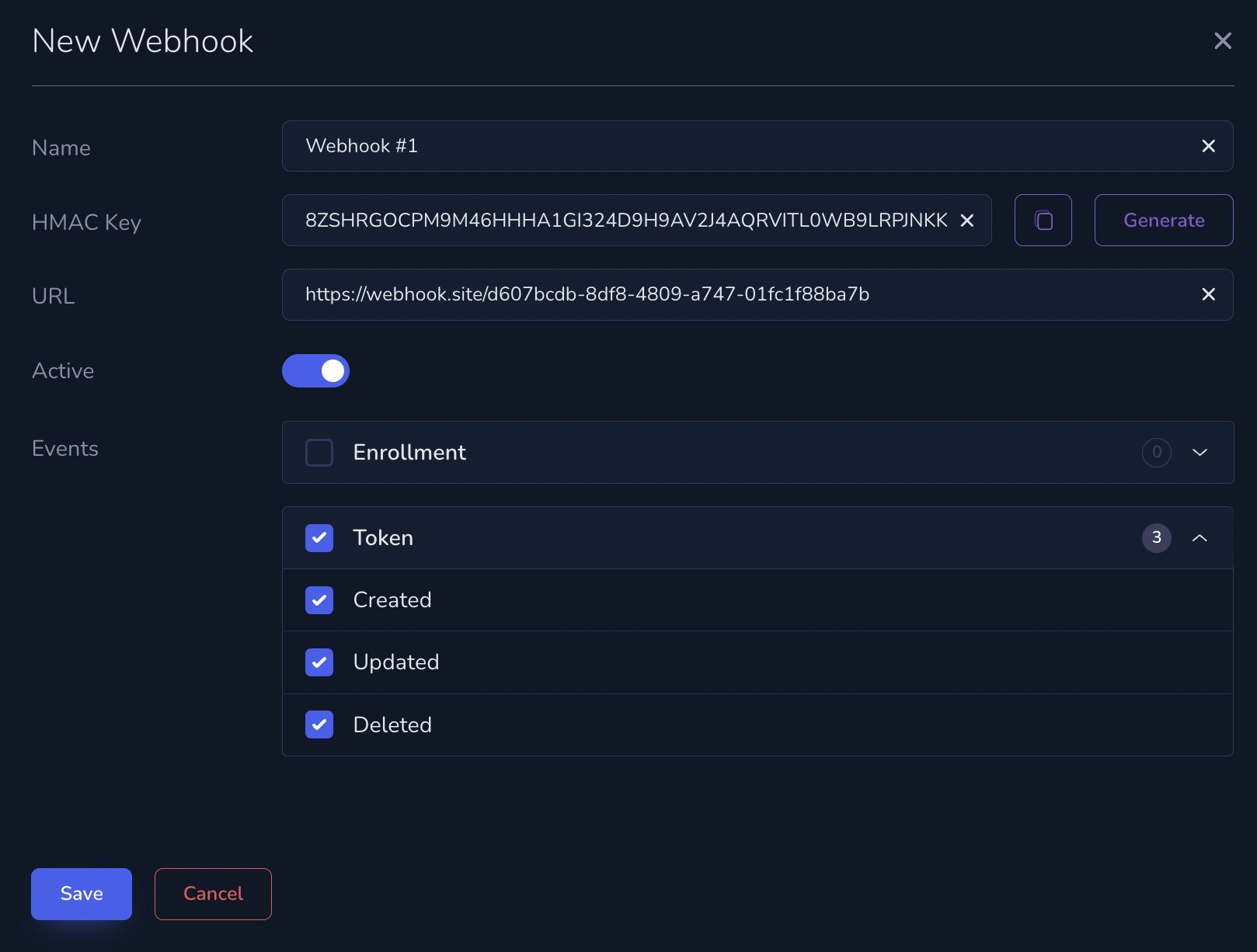
Create new Webhook
In our API Documentation, certain endpoints include a Callbacks section detailing the availability of webhooks.

Webhook Structure

Each Webhook event includes the following fields:
  • id: A unique identifier for the event that triggered the notification.
  • created_at: The timestamp of when the event occurred, formatted in ISO 8601.
  • event_type: The type of event, as described below in the Events section.
  • object: The structure of the object varies depending on the event type.

Example

{
  "id": "6a757512-44e8-44cd-ad82-f7e9da2f353a",
  "created_at": "2024-08-09T09:08:20.809661Z",
  "event_type": "token.created",
  "token": {
    "account_number_last_four": "3490",
    "account_number_length": 16,
    "authentication_data": {},
    "bank_name": "Intl Hdqtrs-Center Owned",
    "cardholder_name": "John Doe",
    "country_code": "US",
    "created_at": "2024-08-09T09:08:20.798263Z",
    "expires_at": null,
    "expiry_month": 12,
    "expiry_year": 2025,
    "id": "6a757512-44e8-44cd-ad82-f7e9da2f353a",
    "identity_and_verification": "none",
    "invalidated_at": null,
    "issuer_identification_number": "46229431",
    "masked_account_number": "462294XXXXXX3490",
    "network_token_status": "pending",
    "scheme": "VISA",
    "segment": "consumer",
    "status": "active",
    "supports_device_binding": false,
    "type": "debit"
  }
}

Retry Strategy

When Commerce sends a notification to your integration server, the server’s response determines whether Commerce considers the notification successfully delivered or if it should retry.
  • HTTP 200 (OK): Commerce treats this as a successful delivery, and no retries will be made.
  • Any Other HTTP Code: Commerce considers this a failed delivery attempt and will initiate retries.
Retry Schedule: If the server responds with a code other than 200, Commerce will retry the notification immediately. Subsequent retries occur at intervals of 15 seconds, 30 seconds, 60 seconds, and 120 seconds, totaling 5 attempts.

Verify webhook signatures with HMAC

Verify that webhook events were sent by Commerce and have not been altered in transit by checking the x-hmac-signature header.

HMAC Key

The HMAC key is randomly generated when you create a webhook and consists of a 64-character string that includes digits (1-9) and uppercase letters (A-Z).

HMAC Signature

The x-hmac-signature header is a base16-encoded (hex) Message Authentication Code (MAC) generated from the raw request payload using your HMAC key and SHA256.

How to verify

  1. Calculate the HMAC using:
    • The raw payload you received in the webhook body
    • Your HMAC key
    • The SHA256 hashing function
  2. Compare the calculated value with the x-hmac-signature header you received.
If they match, the webhook was sent by Commerce and was not modified in transmission.

Example

Example HMAC key:
APJ29CF5LPFXC189YPJT2HX92P0HKVINX63N4TE4WOCUYBT3LKBAQIF25I423DCA
Example payload and corresponding x-hmac-signature:
{
  "id": "6a757512-44e8-44cd-ad82-f7e9da2f353a",
  "created_at": "2024-08-09T09:08:20.809661Z",
  "event_type": "token.created",
  "token": {
    "account_number_last_four": "3490",
    "account_number_length": 16,
    "authentication_data": {},
    "bank_name": "Intl Hdqtrs-Center Owned",
    "card_art_url": null,
    "cardholder_name": "John Doe",
    "country_code": "US",
    "created_at": "2024-08-09T09:08:20.798263Z",
    "expires_at": null,
    "expiry_month": 12,
    "expiry_year": 2025,
    "id": "6a757512-44e8-44cd-ad82-f7e9da2f353a",
    "identity_and_verification": "none",
    "invalidated_at": null,
    "issuer_identification_number": "46229431",
    "masked_account_number": "462294XXXXXX3490",
    "network_token_status": "pending",
    "scheme": "VISA",
    "segment": "consumer",
    "status": "active",
    "supports_device_binding": false,
    "type": "debit"
  }
}
x-hmac-signature for the above payload:
7d2a6ac096d31e4b27c2efc44c0966498007b4aeffdfbb54da55d258911dbaf5
Example verification in Node.js:
const crypto = require('crypto');

function sign(payload, hmacKey) {
  const payloadBuffer = Buffer.from(payload, 'utf-8');
  const keyBuffer = Buffer.from(hmacKey, 'utf-8');
  const hmac = crypto.createHmac('sha256', keyBuffer);
  hmac.update(payloadBuffer);
  return hmac.digest('hex');
}

// Example usage:
const payload = '{"id":"3be16244-9b33-476d-9cd1-24c6975d2faa",...}';
const hmacKey = 'APJ29CF5LPFXC189YPJT2HX92P0HKVINX63N4TE4WOCUYBT3LKBAQIF25I423DCA';
const signature = sign(payload, hmacKey);
console.log(signature);
The computed signature should match the x-hmac-signature header. If it does, the webhook is legitimate.